
How One Digital Twin Supported a Building From Construction Through Renovation
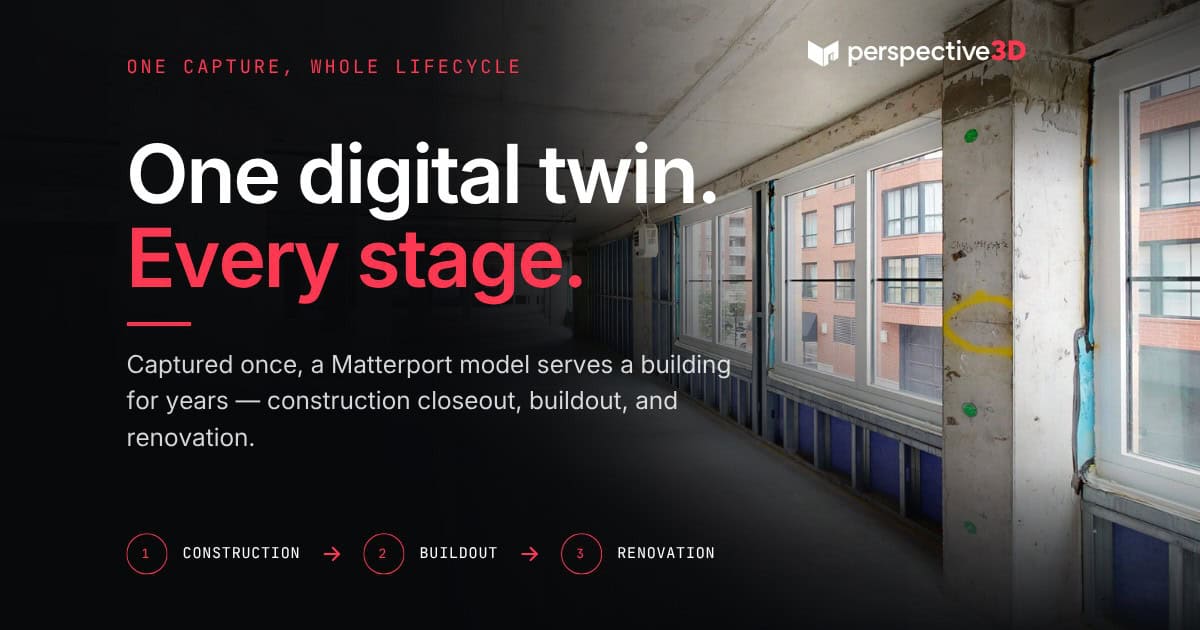
Matterport digital twins captured once can serve a building for years — through construction closeout, a tenant buildout, and a later renovation — because they’re a permanent spatial record, not a deliverable tied to a single project phase. The scan doesn’t expire when the punch list closes.
This post is for building owners, GCs, and facility managers deciding whether a digital twin is worth the cost if it’s only used once. After reading, you’ll know how Matterport digital twins hold up across a building’s life, where they’re useful, and where they aren’t.
What makes Matterport digital twins different from a one-time deliverable?
A digital twin is a dataset, not a photo set. When Perspective 3D captures a Matterport scan, the output includes a navigable 3D model, measurements accurate to industry tolerances, and floor plans generated directly from the scan. That data doesn’t degrade. A punch-list photo answers one question on one day. A digital twin can answer new questions years later — where a wall actually sits, how tall a ceiling clearance really is, what conduit routing looked like before drywall went up — because the spatial record stays intact. The National Institute of Building Sciences has pointed to the same problem with traditional as-built documentation: it’s captured once, then rarely kept current.
That’s the core idea behind Matterport digital twins — one accurate record, reused at every stage instead of recreated each time. The scan doesn’t need to be redone every time someone needs building information. It needs to be findable and current enough for the question being asked.
How does a digital twin support construction closeout?
At closeout, a digital twin documents as-built conditions before walls, ceilings, and finishes hide what’s behind them. GCs use it to verify that installed systems match approved drawings, and owners use it to confirm they’re receiving what they paid for. If a dispute comes up later about whether a fire-rated assembly was installed correctly, the scan is a timestamped record — not a memory or a photo taken from an angle that doesn’t show the detail in question.
For municipalities and commercial owners managing multiple buildings, closeout scans also standardize documentation across projects. Every building gets the same type of record, captured the same way, which makes comparing buildings or handing off a portfolio to a new facilities team more consistent.
Can a scan from initial construction still be useful during a later renovation?
Yes, if the building hasn’t changed significantly since the scan was captured. A renovation team can pull existing floor plans and dimensions straight from the original digital twin instead of re-measuring the building from scratch. That saves site visits and reduces the risk of working from outdated as-builts that never matched the finished construction.
The scan is most useful for structural and dimensional questions — where columns sit, what a room’s actual square footage is, how a corridor width compares to code. It’s less useful for anything that’s changed since capture: new equipment, altered layouts, updated finishes. Matterport digital twins work this way in practice — reuse what still holds true, recapture only what’s changed.
What happens when ownership or tenants change?
A digital twin transfers with the building record, giving a new owner or tenant a documented starting point instead of a blank slate. During due diligence or lease negotiations, buyers and tenants can walk the space remotely, verify square footage, and check clearances before committing. For facility managers taking over a building they didn’t build, an existing scan shortens the ramp-up time needed to understand the space.
This matters most for buildings that change hands more than once. Each transition is usually when building documentation gets lost — files misplaced, drawings outdated, institutional knowledge walking out the door with the previous owner’s team. A digital twin tied to the building, not to a single owner’s records, survives that gap.
A Grand Rapids-Area Example: One Scan, Three Building Events
Here’s an illustrative scenario, based on the pattern we typically see with commercial buildings in West Michigan — not a specific verified client, but a composite of how this plays out. Consider a mixed-use commercial building in the Grand Rapids area, built out for a ground-floor retail tenant and second-floor offices. At construction closeout, the GC commissions a Matterport scan to document as-built conditions for the owner’s records.
Two years later, the ground-floor tenant leaves and the space needs a buildout for a new tenant with different requirements. Instead of sending a team to remeasure the entire space, the design team pulls the original scan to confirm wall locations, ceiling heights, and existing MEP routing before drawing new plans. It saves a site visit and gives the architect a starting floor plan on day one.
A year after that, the building sells. The new owner’s due diligence team uses the same digital twin to verify square footage and walk the second-floor offices remotely before the purchase closes. One scan, captured for one purpose, ends up supporting three separate building events over three years. That’s the practical case for treating a digital twin as infrastructure for the building, not a one-off deliverable for a single project.
Where This Approach Breaks Down
A digital twin only reflects the building as it existed on the day of capture. If a building has gone through significant changes — new walls, structural modifications, major system replacements — an old scan will actively mislead anyone who treats it as current. Relying on outdated spatial data during a renovation can lead to wrong assumptions about clearances or dimensions, which is worse than having no scan at all.
A digital twin also isn’t a substitute for code review, structural engineering, or a permit set. It documents what exists. It doesn’t tell you what’s allowed, what’s structurally sound, or what a renovation will require from a compliance standpoint. And a scan captured for one purpose — say, marketing a leasable space — may not have the coverage or accuracy needed for construction-grade decisions. If precise measurements matter for the next phase, confirm the scope of the original capture before assuming it’s sufficient. Matterport digital twins only hold value if someone keeps the file current — an untouched scan from years ago is a liability, not an asset.
Our guidance: treat any scan older than two to three years, or any building with known changes since capture, as a reference point that needs verification — not a final answer.
FAQ
How long does a Matterport digital twin stay accurate?
It stays accurate for whatever hasn’t changed since the day it was captured. Structural elements like columns and exterior walls tend to hold up well over time. Anything altered by renovation, tenant changes, or system upgrades needs a new scan to reflect current conditions.
Do we need a new scan for every renovation, or can we reuse the original?
It depends on scope. If the renovation touches areas covered by the original scan, that data can inform planning. Areas being demolished, rebuilt, or altered should be rescanned to confirm current conditions before design work proceeds.
Who typically owns the digital twin file after a project closes?
Ownership depends on the contract between the client and Perspective 3D at the time of capture. Building owners commissioning a scan for their own records typically retain the deliverable for use across future projects and transitions.
Can a digital twin replace as-built drawings?
A digital twin supports as-built documentation but isn’t automatically a substitute for stamped drawings where those are required. It provides accurate spatial and dimensional data that architects and engineers can use to produce or verify as-builts.
Is a digital twin useful for buildings that aren’t being renovated or sold?
Yes. Facility managers use digital twins for space planning, maintenance reference, and emergency response documentation, independent of any renovation or sale. The value isn’t tied to a transaction — it’s tied to having an accurate record available when a question about the building comes up.
How much does it cost to reference an existing scan versus commissioning a new one?
Referencing an existing scan has no additional cost beyond accessing the file. A new scan is priced based on square footage and scope, similar to the original capture. Confirm with Perspective 3D whether your building’s conditions warrant a full rescan or a partial update.
Related Reading
- Before a building sale closes, see why buyers should confirm conditions with a 3D scan before acquisition due diligence.
- For the full picture of how documentation needs shift from purchase to sale, read about 3D documentation across the building lifecycle.
- To understand the broader shift in project management, see what a Matterport digital twin changes about a project.
- For the concept behind treating a single scan as a lasting building record, read about the Golden Thread connecting Michigan businesses through 3D documentation.
Call 616-312-3947 or visit perspective3-d.com/contact to discuss documenting your building for the long term.