
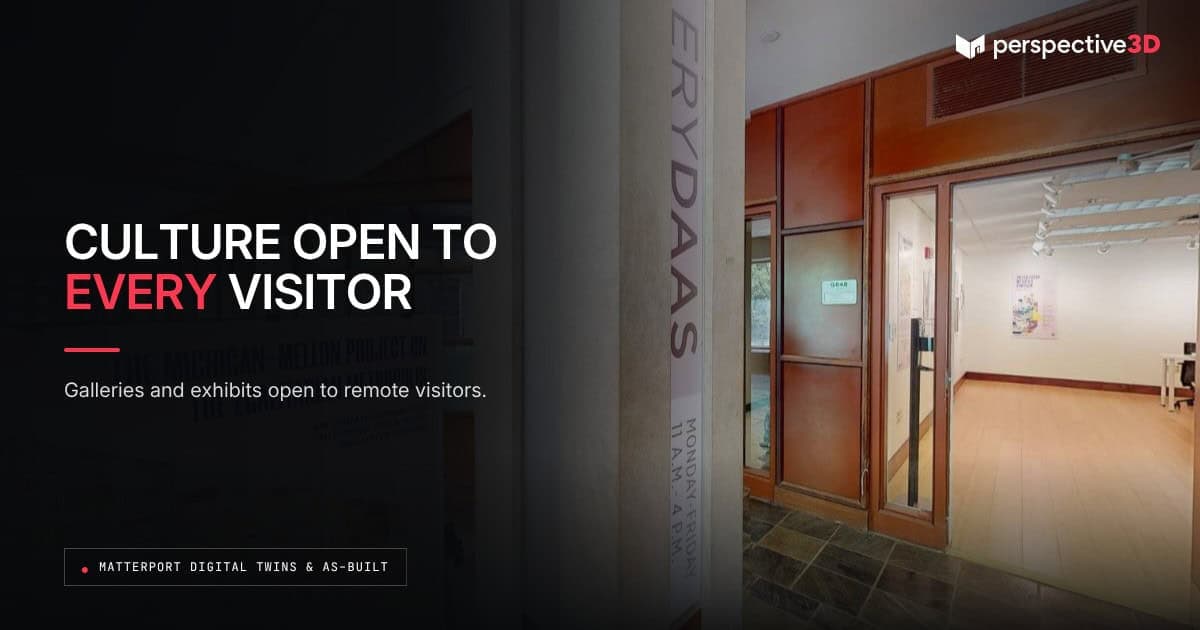
A Matterport digital twin lets someone who can’t physically attend a gallery, museum, or festival still see the work and move through the space. That’s what ArtPrize digital accessibility DisArt matterport projects have done in Grand Rapids: turned physical exhibits into spaces people can visit from anywhere. This post is for gallery directors, museum staff, and event organizers who want to know how a 3D scan extends a physical exhibit to people who can’t be there in person.
What does “digital accessibility” mean for an art exhibit?
It means someone who can’t climb stairs, can’t travel to Grand Rapids, or can’t tolerate a crowded venue can still walk through the exhibit, view the work at their own pace, and understand how pieces relate to each other in the space. A Matterport tour reproduces the layout of the venue, not just photographs of individual pieces, so the visitor experiences the exhibit as a space, not a slideshow.
How did this work for ArtPrize and DisArt specifically?
P3D captured exhibit venues as part of ArtPrize and DisArt programming, giving remote visitors a way to walk through the same rooms local attendees walked through in person. For DisArt in particular, which centers disability and access in its programming, a navigable digital twin isn’t a bonus feature. It’s consistent with the mission. Someone who can’t physically attend gets a version of the exhibit that isn’t a downgrade, just a different way in.
What can a venue capture, beyond just the walls and floor?
The scan captures the full room: lighting, layout, signage, and the placement of each piece relative to the others. Viewers can move from room to room the way they would on foot, which matters for exhibits where sequence or spatial relationship is part of the artistic intent. It’s not a substitute for standing in front of a piece, but it’s closer to that experience than a photo gallery on a website.
How much lead time does a venue need to schedule this?
Capture typically needs to happen before or after public hours, so venues should schedule it a week or two ahead of an opening if the digital twin is meant to be live on day one. For multi-venue events, each location gets scheduled separately, usually across a few days depending on how many sites are involved. Scheduling early is part of what makes artprize digital accessibility disart matterport work possible without disrupting programming.
Where does a digital twin fall short for an art exhibit?
Texture, scale in physical space, and the experience of sound in a room don’t fully translate through a screen. A sculpture’s actual weight or a painting’s brushwork reads differently in person than in a scan. A digital twin extends access. It doesn’t reproduce every sensory detail of standing in the room. For exhibits where that distinction matters most, pair the digital twin with detailed photography of individual pieces.
Frequently Asked Questions
Does ArtPrize digital accessibility or DisArt Matterport scans disrupt the exhibit during capture?
No. Capture typically happens before or after public hours, and takes a few hours depending on venue size, so it doesn’t interfere with visitor traffic.
Can visitors interact with the digital twin themselves, or is it just a fixed video?
Visitors navigate the space themselves, moving room to room, looking around, and zooming in on specific areas, the same way they’d move through the room in person.
Does this work for outdoor or multi-venue exhibits?
Yes, with some adjustments. Outdoor spaces and multiple venues can each be captured and linked together so a visitor can move between them in one continuous digital experience.
Who owns the digital twin after the event ends?
The venue or event organizer owns the deliverable. Many organizations keep the model live after the event closes, since it continues to serve people who couldn’t attend during the run. Every artprize digital accessibility disart matterport capture we’ve done has followed this same process.
Related Reading
- How a 3D Scan Makes a Physical Space Available to Everyone
- What ADA Compliance Documentation Actually Requires — and How We Support It
Interested in a digital twin for your venue or exhibit? Call 616-312-3947 or visit perspective3-d.com/contact.