
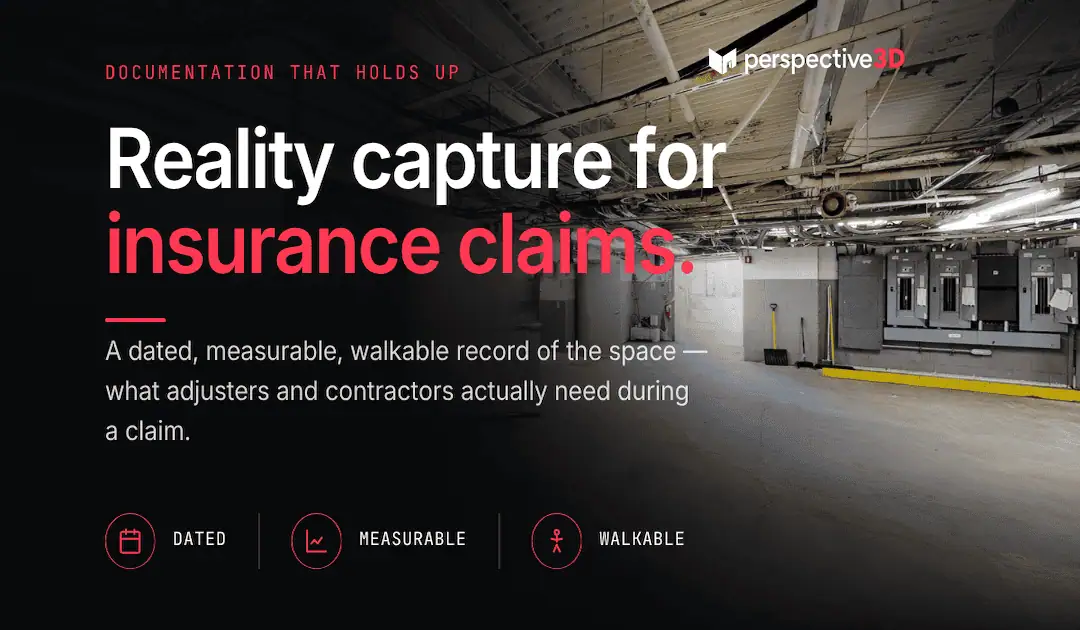
Reality Capture for Restoration and Insurance Claims: What Documentation Actually Holds Up
A Matterport scan gives a restoration or insurance claim a dated, measurable, walkable record of the space. That record supports insurance claims and restoration scoping in ways photos and written notes can’t match on their own.
This post is for restoration contractors, insurance adjusters, property owners, and facility managers who need to know what documentation actually stands up during a claim, and what it doesn’t do for them.
What makes documentation hold up in a claim?
Documentation holds up when it’s dated, measurable, and hard to dispute. A claim file built on photos alone leaves gaps: no consistent scale, no record of what’s outside the frame, no way to verify a room’s dimensions after the fact. A Matterport scan captures the whole space in one pass, with measurements embedded and a timestamp attached. When a question comes up later about condition, layout, or extent of damage, the scan answers it without relying on someone’s memory of the site visit. Industry restoration standards from the IICRC emphasize the same principle for insurance claims — documented, dated conditions reduce disputes over scope and cause.
How is a Matterport scan different from photos and field notes?
A scan is navigable and measurable; photos and notes are not. Photos show what the camera was pointed at, at one moment, from one angle. Field notes depend on what the person on-site chose to write down. A Matterport scan captures the full room geometry — walls, ceilings, floors, fixtures — so anyone reviewing the file later can walk through the space, pull a measurement, or check a detail that wasn’t the focus of the original visit. That matters for insurance claims that get reopened, disputed, or handed to a second adjuster who never saw the property.
When during a claim should the scan happen?
The scan should happen as close to the loss event as scheduling allows, before repair work changes the site. Once demolition or mitigation starts, the original condition is gone. A same-week or next-day scan captures the property as the loss left it — water lines, structural damage, contents in place. If the property owner or contractor needs to move fast on mitigation, coordinate the scan first or in parallel; a short delay for documentation is easier to justify than a claim with no baseline record.
Who typically requests the scan — the contractor, the adjuster, or the property owner?
Any of the three can request it, depending on who owns the risk. Restoration contractors often schedule the scan to protect their own scope of work and support their invoice. Adjusters may request one when a file needs independent, third-party documentation before approving a claim. Property owners and facility managers sometimes commission scans proactively, especially on commercial buildings, so a baseline record already exists before a loss occurs. Whoever requests it, the deliverable is the same: a dated record that all parties can reference.
What does this look like in practice?
Consider a general scenario common to West Michigan property managers: a multi-unit building in Grand Rapids has a pipe failure that floods two floors overnight. The restoration contractor calls for a same-day scan before mitigation crews start pulling drywall. The scan documents water lines on the walls, the condition of flooring and ceilings, and the layout of affected units — all measurable and timestamped. When the adjuster reviews the claim a week later, they can walk through the scan and see the extent of damage as it existed before repairs began, rather than relying only on the contractor’s photos and written scope.
Where does a scan fall short in a claim?
For insurance claims, a scan is one input to the file — it doesn’t determine coverage, cause, or settlement value. Those are the adjuster’s judgment calls, made against the specific policy’s terms. A scan won’t identify the cause of a leak, assign fault, or resolve a coverage dispute. It also won’t replace moisture readings, structural engineering reports, or other specialized inspections that a claim may require.
Frequently Asked Questions
Does a Matterport scan replace photos entirely?
No. Photos still have a place for close-up detail shots — a cracked pipe fitting, a specific material defect. The scan covers the whole space with consistent measurements; photos fill in close-range detail the scan isn’t built for. Most claim files benefit from both.
Will an insurance adjuster accept a 3D scan as documentation?
Most adjusters accept scans as supporting documentation, since the format is dated, measurable, and easy to review remotely. Acceptance as sufficient evidence for a specific coverage decision still depends on the adjuster and the policy. Confirm with the adjuster or carrier early if a scan needs to meet a specific documentation requirement.
How long does a scan take on a restoration site?
Most residential and small commercial spaces take one to a few hours to scan, depending on square footage and the number of rooms affected. Larger commercial properties take longer. We confirm timing and access requirements when the job is scheduled.
Can a scan be used months after the loss for comparison?
Yes. The dated scan file remains available for reference throughout the life of the claim. If a pre-loss scan of the property also exists, the two can be compared side by side to show what changed.
Does P3D determine the scope of damage or the claim value?
No. We capture and deliver the documentation. Scoping the damage and valuing the claim is the job of the adjuster, the contractor, and the policy terms — the scan supports that work, it doesn’t replace it.
What file formats are delivered for claims documentation?
Deliverables typically include a navigable Matterport digital twin, measurement data, and still images pulled from the scan. We confirm the format needed for a specific claim file or software system before the job is scheduled.
Related Reading
- For a broader look at scanning during property transactions, see 3D scanning for building acquisition due diligence.
- To understand how documentation timing changes before and after a loss, see pre-loss and post-loss 3D scanning.
- If you’re deciding whether a claim or project needs a scan at all, see when to hire a 3D scanning company.
Call 616-312-3947 or visit perspective3-d.com/contact.