
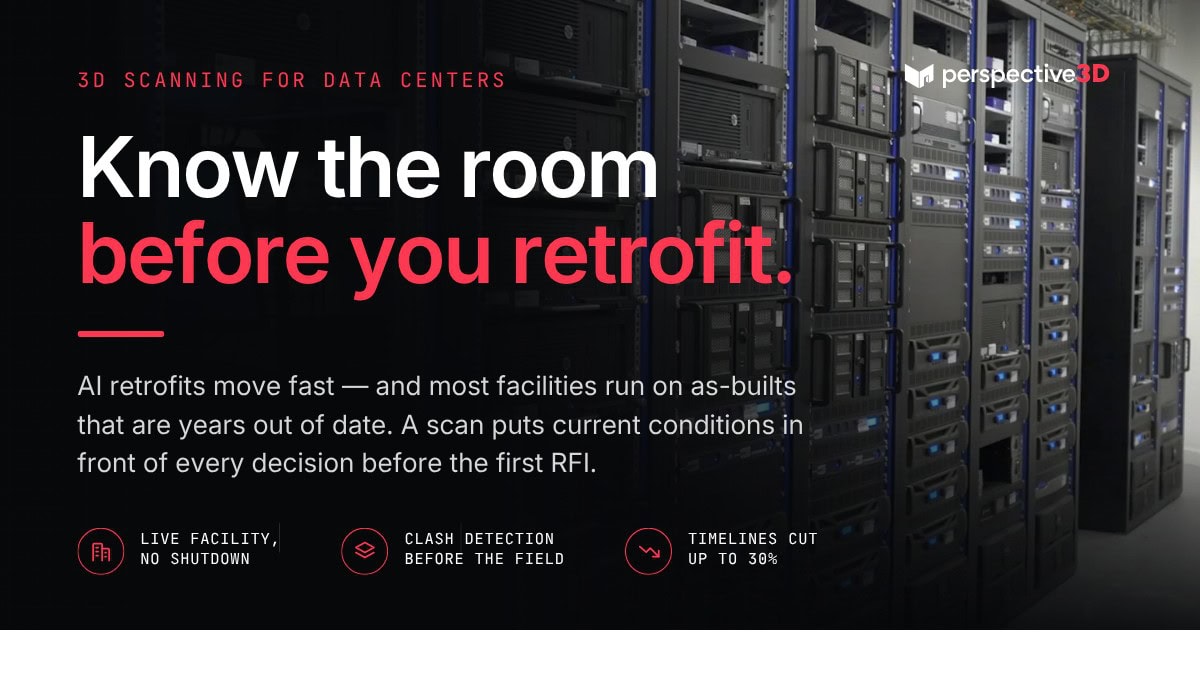
3D scanning for data centers is something Perspective 3D has been doing since 2015 — and the demand has never been higher. The facilities keeping your AI tools running need accurate documentation of their own, and most of them don’t have it.
Across the United States, data centers built for traditional server workloads are being rapidly reconfigured to support GPU-dense computing clusters, liquid cooling systems, and upgraded power distribution architectures. GPU-dense racks for AI training and inference can draw 40–100+ kW per rack, compared to 5–15 kW for traditional compute racks. The pressure to retrofit existing facilities is outpacing the documentation methods those facilities have relied on for years.
That gap is where 3D scanning for data centers has become essential — and why digital twins are now a standard tool for facilities directors and developers who need to see what’s actually inside their buildings before making decisions about what happens next.
The AI Retrofit Wave Is Exposing a Documentation Gap
Most facilities are still working from legacy CAD drawings, outdated floor plans, and manual field measurements. These sources are often years out of date and rarely reflect real-world conditions after multiple rounds of upgrades.
The cost of operating from inaccurate documentation is real. Unplanned downtime at a major data center can run between $100,000 and $500,000 per hour. Retrofitting live, operational data centers introduces significant risk — temporary cooling outages, loss of redundancy, and accidental downtime — all of which require early-stage identification and mitigation. Working from documentation that doesn’t reflect current conditions makes that risk harder to manage, not easier.
3D laser scanning provides the spatial data needed to plan liquid cooling retrofits, rear-door heat exchanger installations, and hot/cold aisle containment modifications. By capturing as-built conditions accurately, facility teams can identify clearance constraints for new cooling distribution units and verify that planned equipment fits within existing structural and spatial envelopes — before breaking ground on the retrofit.
What a Digital Twin Actually Provides
A digital twin is not just a visual walkthrough. It is a dimensionally accurate, photorealistic 3D model of a real environment — one that includes metadata, spatial context, and time-stamped visual records of the physical space at the time of capture.
For a data center, that means every stakeholder — engineers, contractors, facilities managers, ownership — can access a single, accurate model of the space without requiring an on-site visit. Through integration with platforms like Autodesk and Procore, teams can work collaboratively to speed up as-built documentation, share BIM files directly into design packages, and streamline project management across construction sites.
The practical value is in what that access replaces: site visits into live environments, manual re-measurement, version-controlled spreadsheets that don’t match the floor, and contractor RFIs that could have been answered with a walkthrough.
How 3D Scanning for Data Centers Reduces Retrofit Risk
Remote pre-construction walkthroughs. Engineers can tour the facility virtually, examine clearances, and identify conflicts before entering a live environment — reducing exposure for both personnel and operations.
Clash detection before it reaches the field. Point cloud data supports clash detection between ductwork, piping, and cable trays, as well as CRAC/CRAH unit relocation, electrical conduit routing for new circuits, and above-ceiling MEP documentation — all verified before physical work begins.
Phased documentation for draw schedules. A scan at each project milestone creates a timestamped visual record that supports draw requests and protects all parties when conditions are disputed.
Ongoing facilities management. A digital twin can be integrated with DCIM systems, building management systems, asset management databases, and capacity planning tools — linking physical locations to power, cooling, and capacity metrics. The twin becomes a permanent operational asset, not a one-time deliverable.
Why the Documentation Window Matters Now
Retrofit project timelines can be condensed by up to 30% by reducing time in site development and utility setup — but that compression requires accurate existing-conditions documentation from the start. Facilities that begin retrofit planning without current as-built records lose that advantage immediately.
Perspective 3D has been delivering 3D scanning for data centers and critical infrastructure environments since 2015. What we see consistently across those projects: the documentation gap is rarely obvious until a project is already underway. A digital twin captured before work begins changes the planning conversation entirely — it puts accurate conditions in front of every decision-maker before the first RFI is issued.
You Don’t Need to Own Specialized Equipment
Many facility managers don’t realize: you don’t need to purchase scanning equipment or navigate a corporate sales process. Certified service providers bring professional equipment directly to your facility — anywhere in the country.
Perspective 3D is a certified, woman-owned 3D scanning service provider based in Grand Rapids, Michigan — available nationwide. Whether you manage one mission-critical facility or a portfolio of data centers across multiple markets, we coordinate scheduling, capture the space on site, and deliver documentation in the formats your team actually uses.
Spatial Data as a Strategic Asset
The operators moving fastest in 2026 are doing so with better information. A digital twin functions as a living infrastructure record — one that evolves alongside the physical building and supports planning, communication, and decision-making across the building lifecycle.
It also improves external presentation: lenders, tenants, and stakeholders can review a complete, navigable representation of the asset without relying on static reports or outdated visuals, reducing friction in due diligence. A data center that can hand a prospective lender or tenant a timestamped, navigable documentation record carries that into due diligence as a verifiable record — not a sales claim.
Ready to Document Your Facility?
Wherever your data center or critical infrastructure is located, Perspective 3D comes to you. No equipment purchase, no corporate process — just accurate as-built documentation delivered to your facility. Contact us for a free quote.
Frequently Asked Questions
How long does a data center scan take?
Most standard data hall environments can be captured in a single day. Larger multi-floor facilities typically require two to three days. We coordinate with your team to minimize operational impact.
Can the digital twin integrate with BIM or facility management systems?
Yes. Digital twin exports support multiple BIM-compatible formats, and the model can be shared via browser link with any stakeholder — no software installation required. Integration with platforms like Autodesk Revit and Procore is supported through standard file exports and third-party workflows.
Do I need to own scanning equipment?
No. Perspective 3D brings all equipment and manages the entire process. You receive a complete hosted digital twin — no hardware or subscription required on your end.
Can you scan facilities outside of Michigan?
Absolutely. We’re based in Grand Rapids but travel anywhere in the United States. We’ve documented critical infrastructure facilities across multiple markets and can coordinate multi-site deployments with consistent standards and uniform deliverables.
What types of data center environments have you documented?
Perspective 3D has been delivering 3D scanning for data centers since 2015 — including colocation facilities, enterprise data halls, and industrial compute environments. We coordinate with facilities teams to minimize operational impact and deliver documentation that meets the requirements of engineers, contractors, and ownership.