
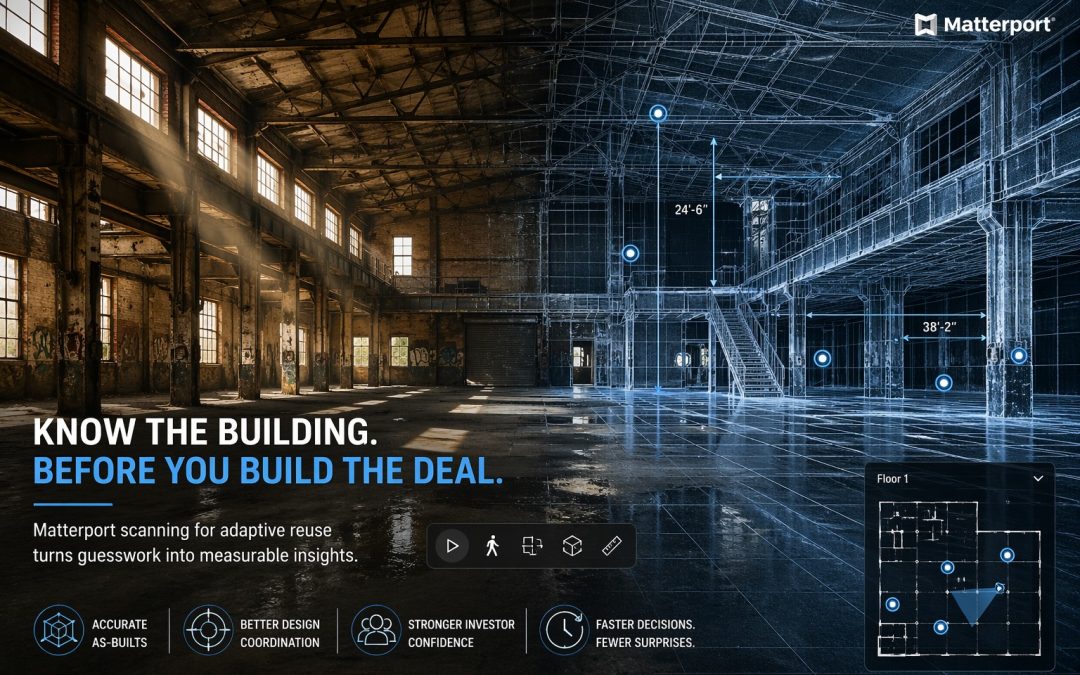
The building you’re about to redevelop was probably designed before Reagan took office. The drawings are missing, the ones you found are wrong, and the last tenant removed a load-bearing wall without telling anyone. Welcome to adaptive reuse — the fastest-growing corner of 2026’s development market, and the one where Matterport scanning for adaptive reuse has become table stakes.
Architectural Record’s 2026 adaptive reuse issue confirms what developers already feel: roughly 90% of development projects in the next decade will involve some form of adaptive reuse. Warehouses becoming residential. Factories becoming mixed-use. Churches becoming event venues. And every one of those pro formas depends on knowing exactly what you’re working with before the first demo permit is filed.
The As-Built Gap No One Wants to Talk About
Here’s the uncomfortable truth on most adaptive reuse projects: the drawings either don’t exist or can’t be trusted. You inherit a building with decades of undocumented modifications — utility runs, structural retrofits, HVAC replacements, partition walls put up and torn down. Even when original plans are on file, they reflect the building as it was designed, not as it sits.
That gap costs developers money in three predictable places:
- Pro forma accuracy — square footage, ceiling heights, and usable floor area that drive rent assumptions
- Design-phase change orders — architects discovering conditions mid-drawing that don’t match what they were told
- Investor confidence — capital partners want documentation, not guesses, before they commit
A Matterport digital twin collapses all three problems into one scan day. A navigable, measurable, shareable 3D model of the building as it actually exists — not as someone remembers it.
Three Ways Adaptive Reuse Developers Use Matterport Right Now
1. Pre-Development Documentation Before the Deal Closes
The strongest use case is the earliest. Scan the building during due diligence and you walk into the LOI with measured floor plates, verified ceiling heights, and a digital twin your entire deal team can tour from their desks. No more scheduling five separate site walks for architects, engineers, investors, and your general contractor. One scan. Everyone sees the same building.
2. Design and Construction Coordination
Once the deal closes, that same scan feeds your design team. A Matterport digital twin — paired with downloadable point cloud data — becomes the measured baseline for scan-to-BIM modeling, clash detection, and MEP routing. Architects stop drawing from photographs and field measurements. They draw from reality. Our scan-to-BIM workflow
3. Investor and Stakeholder Communication
Adaptive reuse is a story. Investors buy the story. A Matterport tour embedded in your investor deck lets LPs walk the building without flying in. It does the same work for city councils during entitlements, for anchor tenants deciding on lease terms, and for your lender’s credit committee reviewing the loan package. One model, multiple audiences, no travel.
Why You Don’t Need to Own a Matterport (or Call Their Corporate Office)
Questions we are asked from developers evaluating Matterport tech are “Do we need to buy the cameras?” and “Do we have to go through Matterport’s corporate sales process?” The answer to both is no — and the reason matters more than the answer.
Think of scanning the same way you think about environmental reports or ALTA surveys. Specialized. Occasional. Almost always better handled by a dedicated outside team than built in-house. You call the right firm, they show up with the gear, the workflow, and the QA, and you take delivery of clean files you can actually use.
We capture industrial facilities, churches, shuttered schools, hospital wings, factories, historic buildings that never had real drawings. We operate as a certified woman-owned business (MBE and WBE documentation available when a project’s capital structure requires it), and we work the full country, not a regional footprint.
What You Actually Get
Every scan delivers a navigable Matterport digital twin, schematic floor plans, high-resolution still images (if needed), and if your design team needs it, and point cloud data in standard formats. Learn More
Typical turnaround from scan day to delivered digital twin is 24 hours, depending on the size of the asset and the complexity of the deliverable package.
FAQ
How much of an adaptive reuse building needs to be scanned? Most developers have us scan everything. Interior, exterior, roof when accessible, and mechanical spaces. For phased projects, we can scan in stages.
Can the Matterport model be shared with anyone we want? Yes. Model links can be shared via public or password-protected links, embedded in investor decks, and accessed on any device. There’s no software to install.
What does this cost? Pricing depends on building square footage, site complexity, and deliverable package. Request a quote
The Bottom Line
Adaptive reuse is winning because it’s faster, cheaper, and more sustainable than ground-up — but only when developers walk in with accurate information. Matterport scanning for adaptive reuse is the documentation layer that makes the math work, the design clean, and the investor conversation credible.
Wherever your next project is, we come to you. Get in touch